The Storage Myth: A Box Is Not a Sorting System
A box is not a sorting system: group belongings by how you use them and keep labels visible, so stored items are easier to find and return.
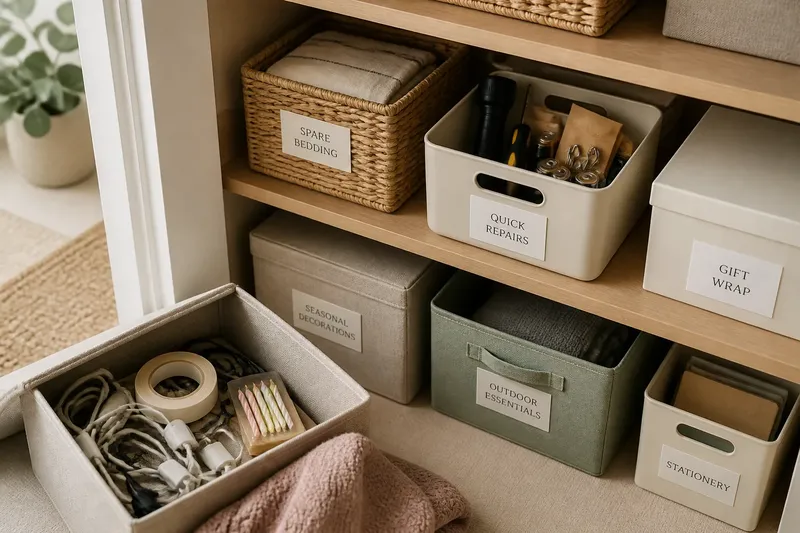
You lift the lid of a storage box looking for spare batteries and meet a tangle of charging cables, birthday candles and a half-used roll of tape. The box is tidy from the hallway. Inside, it is a small search problem. A box is not a sorting system; it is only a boundary around whatever has gone into it.
That distinction matters in cupboards, under beds and on shelves where a neat row of containers can disguise a jumble. Good storage begins with the question, “What do I reach for together?” Once belongings are grouped around that answer, a container can protect the group and a visible label can help you find it again.
Containment and sorting
A container does useful work. It keeps small things from rolling, gathers loose objects, and can make a shelf easier to handle. But it cannot decide which objects belong together, what should be easy to reach, or where an item should go after use. Those decisions are the sorting system.
Imagine you put every object from a bedside table into one lidded box: reading glasses, a notebook, hand cream and spare buttons. The surface looks clear, but the grouping follows the furniture rather than anyone’s routine. If the notebook and glasses are used together, they may deserve a shared, accessible place; spare buttons may make more sense with sewing supplies.
This is not a demand for a container for every category. Too many tiny groupings can create their own fuss. The aim is a useful distinction: keep things together when they serve the same task, and separate them when combining them would make retrieval awkward.
Start with use
Use is a more reliable guide than appearance. Similar objects do not always belong together. A pair of scissors might be used for parcels, sewing or children’s craft work. If you reach for it in several contexts, decide whether one shared home is practical or whether a duplicate you already own would prevent repeated searching.
Begin by looking at the belongings in one small area, rather than emptying an entire cupboard. Notice what you use in the same moment, what gets returned together and what is frequently left out because its home is inconvenient. These patterns point towards groups that support ordinary routines.
Say you find a torch, spare batteries, a small screwdriver and a packet of picture hooks in a hall cupboard. If those items are all used for quick household fixes, imagine placing them in one open-top caddy on a reachable shelf, with the hooks kept in a small envelope inside. The expected observable result is simple: when a minor fix comes up, you can look for the caddy rather than search several boxes.
Keep the group broad enough to be easy to maintain, but not so broad that it becomes a mystery. “Household bits” gives little help. “Quick repairs” tells you more, provided the contents really do serve that task.
Give groups a home
Once a group makes sense, choose a location that fits how often you use it. Everyday items generally need a reachable home. Seasonal or occasional belongings can go higher or further back, as long as the place remains accessible when needed. Think about the route from use to return: a home that is simple to reach and put back is more likely to stay useful.
Match the container to the contents, not the other way round. A shallow tray can keep small stationery visible. A fabric bag may suit spare linens that need to breathe. A sturdy box can gather loose keepsakes that are handled occasionally. Reuse containers you already have where they fit; a container’s usefulness depends on its shape and access, not on having a matching set.
Consider whether a lid helps or hinders. Lids can protect contents and allow stacking, but opening one adds a small barrier. If you reach for something often, an open basket or tray may be more practical. For rarely used items, a lid may keep dust away and make a stack easier to manage.
Leave room to return things without repacking the group each time. A container filled to the brim may look efficient, yet the object at the bottom becomes a nuisance to retrieve. If the contents are hard to see or lift, the category may need dividing, or the container may be doing the wrong job.
Keep labels visible
A label should answer the question you are likely to ask while standing in front of the shelf. Write the group name in plain language, such as “spare bedding” or “gift wrap”, rather than a private shorthand that will lose its meaning. If a box holds several related subgroups, name the broad category on the outside and use small pouches or dividers within it.
Position the label where you can see it without moving the container. On a shelf, the front face is often easiest. In a drawer, the top may be clearer. Use a removable label or masking tape if the contents are likely to change; a permanent marker on a reused box can leave an inaccurate promise behind.
Visibility matters as much as wording. A label hidden behind another box cannot help with finding anything. Nor can a label on a row of identical containers if the fronts are turned away. Arrange containers so their names face the usual approach, and avoid stacking in a way that conceals the categories you need most.
Labels should describe contents, not aspirations. If a box says “craft supplies” but actually holds spare cables and old cards, the mismatch will send you on a search. When the group changes, update the label at the same time.
Labels and groupings?
Should I sort by room or by task?
Choose the arrangement that fits how you look for the belongings. Room-based storage can work for items used in one place, while task-based groups help when a set of objects is carried from room to room.
What belongs in a miscellaneous box?
A small temporary box can collect objects whose homes are not yet clear, but it needs a review point. If it becomes a permanent catch-all, its label tells you where the search problem lives rather than what you can find there.
How specific should a label be?
Use enough detail to distinguish the group from nearby containers, but not so much that ordinary additions make the label false. “Batteries and torch” is clearer than “miscellaneous”, while a long inventory may be tedious to keep current.
What if several people use the storage?
Choose familiar words and put the container where the group naturally looks for the items. A system that makes sense only to the person who arranged it is unlikely to stay intact.
Maintain the system
Storage needs can shift as routines and belongings change. When a container starts collecting unrelated objects, treat that as useful information: perhaps the label is vague, the group is too broad, or the home is inconvenient. Adjust the grouping before adding another box.
When putting something away, take a moment to ask whether it belongs with the items already there. If not, find its existing group or create a sensible one. This small decision prevents the slow drift from organised storage to a tidy-looking jumble.
A box can still be an excellent tool. It becomes part of a sorting system when its contents share a purpose, its place suits the way they are used, and its label remains easy to see. Keep that sequence in mind the next time a box looks full: first decide what belongs together, then choose where and how to contain it.
The most helpful storage label is the one you can read before opening the lid. Make the group visible from where you stand, and the box can finally do its proper job.