A Rainy-Day Audit of the Kitchen Drawer
A kitchen drawer audit helps you group tools by task, spot duplicates and keep the utensils you reach for close at hand without a major clear-out.
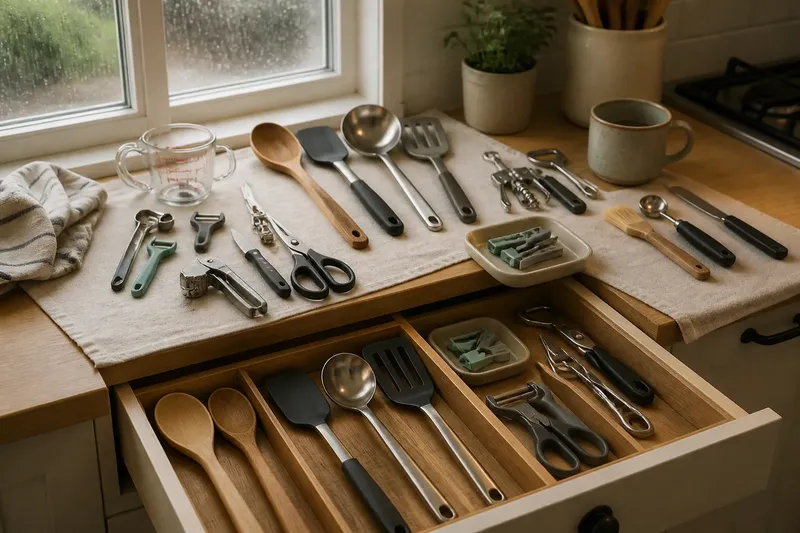
Rain ticks against the kitchen window while a wooden spoon catches on a tangle of measuring cups. You pull the drawer open again, this time with the intention of seeing what is actually in it. A kitchen drawer audit need not become a whole-room decluttering project. It can be a short, calm review of one crowded drawer: group tools by task, notice duplicates, then decide what deserves the easiest reach.
The useful question is not simply, “Do I own this?” It is, “What job does it do here, and how often do I need it?” That keeps the audit grounded in cooking habits rather than abstract rules about how many utensils a home ought to contain.
A bounded review
Imagine a clearly hypothetical situation: Mara has a drawer beside the hob that sticks whenever she tries to retrieve the fish slice. She sets aside a quiet half-hour on a rainy afternoon. Her starting point is a drawer full of cooking tools, spare clips, a corkscrew and a few items she cannot identify at a glance. She wants the fish slice to be easy to grab, not a showroom drawer.
Mara chooses this one drawer and leaves the neighbouring cupboards alone. That boundary matters: if a tool belongs elsewhere, she can note its destination without opening a new sorting task. She also keeps a small tray or clean tea towel nearby for items she temporarily removes. There is no need to buy an organiser before she knows what needs organising.
She clears enough space on the worktop to see the contents, then takes everything out. This makes hidden items visible and lets her wipe the drawer base. If she finds crumbs or sticky residue, she cleans the empty drawer and lets it dry before returning anything. The point is not to create a pristine kitchen; it is to make the contents legible.
For a smaller drawer or a busy day, the same method can be shortened. Set a modest time limit, stop when it ends, and leave unresolved items together in a clearly chosen place rather than scattering them back at random. A review can be useful even if it produces only one clear decision.
Keep the scope small enough to finish without turning the afternoon into a kitchen overhaul.
Groups by task
Mara sorts by the work each tool helps with, not by material or shape. A slotted spoon and fish slice look different, but both may belong to cooking and turning food. A peeler and small paring knife support preparation. Measuring spoons and a small jug help with quantities. This grouping reveals where several tools serve the same task and where a tool has a specialised job.
She makes loose clusters on the worktop rather than building elaborate categories. Her groups are:
- Preparing: peeler, paring knife, garlic press and kitchen shears.
- Stirring and serving: wooden spoon, silicone spatula, ladle and fish slice.
- Measuring: measuring spoons and a small measuring jug.
- Opening and fastening: corkscrew, bottle opener and packet clips.
- Occasional jobs: pastry brush, melon baller and a narrow icing spatula.
These are Mara’s working groups, not a template every kitchen must follow. Someone who bakes often might keep baking tools together; someone who rarely opens bottles may place those tools farther away. The aim is to make a drawer reflect the sequence and frequency of tasks in that particular kitchen.
Grouping also helps distinguish a duplicate from a tool that only looks similar. A wooden spoon and a flat-edged spatula can both stir, but the spatula may scrape a bowl clean while the spoon reaches into a saucepan. The question is whether the difference earns its place in the drawer, not whether two objects share a broad label.
Group by the job you do, then look for tools that genuinely serve the same job.
Duplicates and odd ones
In the preparation cluster, Mara finds three peelers. One has a comfortable handle and a clean, sharp blade. A second is awkward to hold. The third is an unfamiliar spare tucked behind the garlic press. She compares them without assuming that every spare is waste. A backup can be useful, but it need not occupy the prime spot if it rarely comes out.
Duplicates are easier to assess when laid together. For each cluster, Mara asks:
- Do these tools perform the same task, or does one handle a distinct version of it?
- Which one feels easiest to use and is in sound, clean condition?
- Is there a reason to keep a backup, such as a shared kitchen or frequent entertaining?
- Would the less-used item be more helpful stored elsewhere than kept at the front?
Her answer differs by group. She keeps two wooden spoons because one is useful when the other is being washed. She keeps one peeler within reach and sets the awkward one aside for a later decision, rather than making a rushed choice about whether it can be repaired or passed on. The spare peeler goes with other seldom-used tools, not back beside the favourite.
The odd items deserve a fair look, too. Mara cannot recall why a tiny metal scoop is in the drawer. She does not discard it just because its purpose is unclear. She tests her memory against ordinary kitchen tasks: does it belong to coffee, baking or a particular tin? If she cannot place it, she keeps it temporarily with the occasional tools and makes a note to revisit it after using the kitchen as usual. That is more informative than inventing a job for it on the spot.
For items that are damaged, sticky or difficult to clean, use common sense about food contact and condition. Follow the maker’s care instructions where available; if an item is unsafe to use, keep it out of the cooking group while deciding how to dispose of it responsibly.
A duplicate is not automatically clutter; its usefulness depends on the difference it makes in your routine.
What belongs nearby?
The drawer sits beside Mara’s hob, so the returning arrangement should support cooking there. She puts the wooden spoon, silicone spatula, ladle and fish slice at the front. The measuring spoons go beside them because she uses them regularly. The peeler and shears sit together toward one side, ready for preparation without blocking the stirring tools.
The corkscrew and bottle opener move to the back. Mara uses them, but not as often as the cooking utensils. Packet clips go into a small dish she already owns, so they no longer wedge between long-handled tools. The pastry brush and melon baller move to a different kitchen storage spot that suits their occasional jobs. She does not force every item to remain in this drawer merely because it started there.
Reach is a practical choice, not a ranking of importance. A tool used every day may deserve the front even if it is plain and inexpensive. A specialised utensil may earn its place if it solves a task no other tool handles comfortably. Conversely, a novelty tool can be useful to its owner without needing to occupy the easiest-to-reach position.
Mara leaves a little visible space around the longest handles. That makes it easier to grasp one utensil without lifting the whole cluster. She avoids arranging everything in tight, perfect rows; a drawer should still work when someone returns a spoon in a hurry.
Put frequent tools where your hand naturally reaches, and let occasional tools use the less convenient space.
Does this drawer work?
How do I choose what stays in the drawer?
Keep tools that support tasks you do in this part of the kitchen and are convenient to retrieve there. Consider condition, comfort and whether an item has a distinct use, rather than relying on an arbitrary limit for the number of utensils.
Should I keep two versions of one tool?
Keep both if the difference is useful or a spare fits your routine, such as when one tool is often being washed. If they do the same job equally well, choose the one you prefer for easy reach and consider another suitable place for the other.
What if I cannot identify an item?
Do not force a decision while you are unsure. Set the item with occasional tools or in a temporary, visible place, then notice whether you use it during normal cooking before deciding where it belongs.
How often should I review a kitchen drawer?
There is no fixed schedule. Revisit it when a tool becomes hard to find, the drawer starts catching, or your cooking routine changes enough to make the current arrangement inconvenient.
A small result
After arranging the drawer, Mara opens and closes it a few times. The fish slice is easy to pick up, the packet clips no longer snag a handle, and she can see the measuring spoons without shifting the corkscrew. The drawer still contains a few less-used tools. That is fine: the result is a more useful arrangement, not an empty drawer.
She leaves the awkward peeler aside rather than making a disposal decision in the middle of the audit. If it proves useful, she can find a suitable home for it; if not, she can choose a responsible next step. The review has already produced a clear change by moving the tool she reaches for most into an easy position.
For your own kitchen drawer audit, begin with one drawer and let actual use guide the arrangement. Group tools by task, compare duplicates fairly, and keep the everyday utensils within easy reach. The most useful ending may be modest: a drawer that opens cleanly and gives your hand the right tool without a rummage.